Usage Guide
Learn to tune an existing LangChain, LangGraph or Google ADK RAG pipeline, from
installation and a first study to evaluation, caching, resume and result export.
Install tunarag-python and import tunarag.
Prefer a progressive, editable tutorial? Download the DOCX usage handbook.
Purpose and mental model
TunaRAG compares configurations of an existing RAG pipeline. You provide the pipeline, an evaluation dataset, a search space, evaluators, and an objective. TunaRAG schedules trials, isolates failures, persists state, and returns an inspectable result.
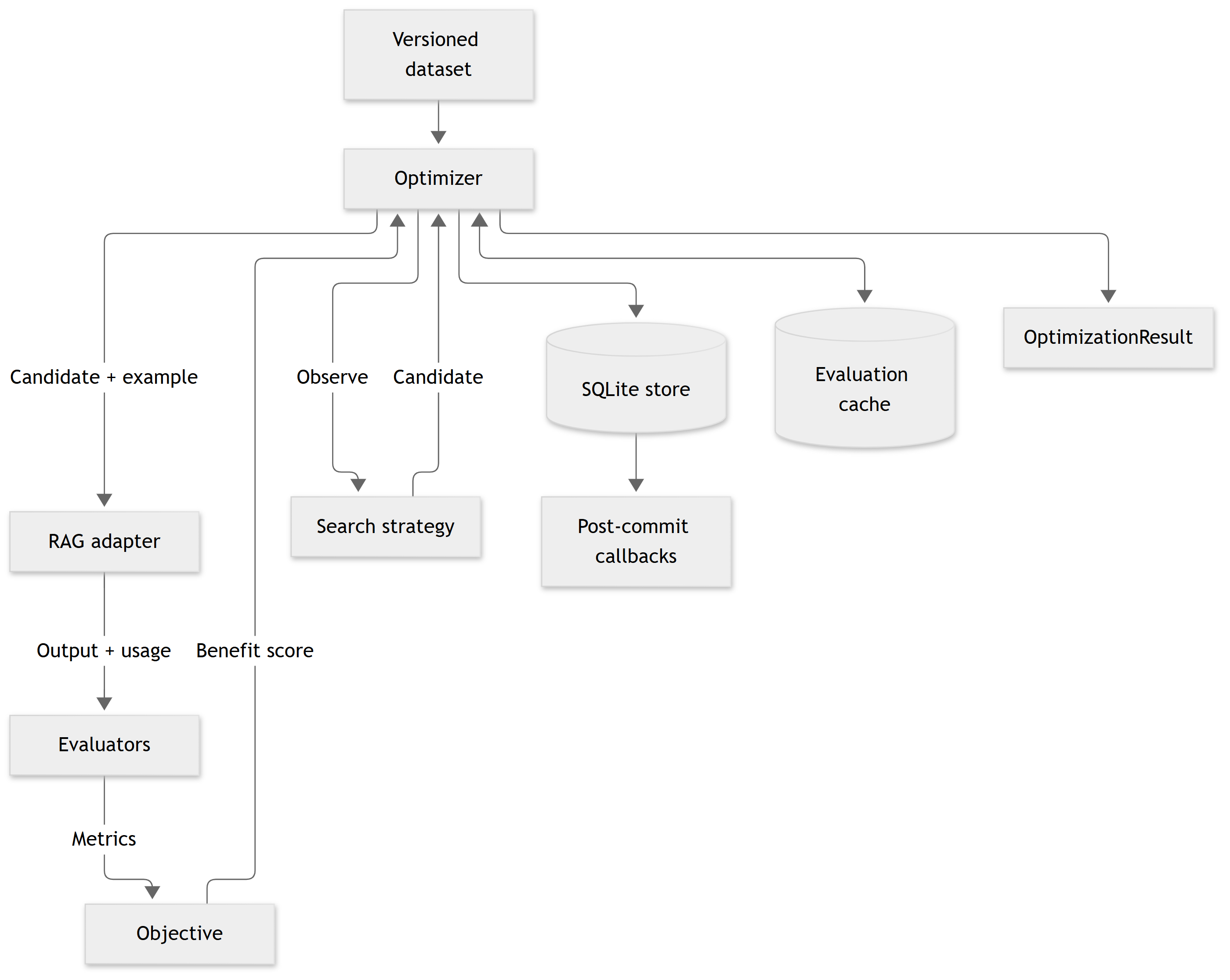
A study contains ordered trials. Each trial evaluates one complete candidate configuration against every dataset example. Same-named sample metrics are aggregated into trial metrics, then the objective converts those metrics into one larger-is-better score.
TunaRAG does not create or host a RAG application, provision indexes, manage provider credentials, or expose a hosted API. Your application keeps ownership of those concerns.
Installation
| Optional feature | Installation |
|---|---|
| LangChain | python -m pip install "tunarag-python[langchain]" |
| LangGraph | python -m pip install "tunarag-python[langgraph]" |
| LangChain and LangGraph; ADK on Python 3.10+ | python -m pip install "tunarag-python[frameworks]" |
| Google ADK 2.x (Python 3.10+) | python -m pip install "tunarag-python[google-adk]" |
| RAGAS | python -m pip install "tunarag-python[ragas]" |
| MLflow | python -m pip install "tunarag-python[mlflow]" |
Framework dependencies load lazily. Install the extra for your pipeline before constructing its adapter. Google ADK requires Python 3.10 or newer; LangChain and LangGraph retain Python 3.10 support.
End-to-end quickstart
Use an installed framework integration. The offline quickstart uses LangChain's vector store, retriever, prompt, and fake model; the provider-backed example uses OpenRouter. Fake embeddings and the fake model test wiring only; their scores do not demonstrate retrieval or answer quality.
from pathlib import Path

from langchain_core.documents import Document
from langchain_core.embeddings import DeterministicFakeEmbedding
from langchain_core.language_models.fake import FakeListLLM
from langchain_core.prompts import ChatPromptTemplate
from langchain_core.runnables import RunnablePassthrough
from langchain_core.vectorstores import InMemoryVectorStore
from tunarag import (
    EvaluationDataset,
    IntegerRange,
    LangChainAdapter,
    MetricEvaluator,
    Objective,
    ObjectiveTerm,
    Optimizer,
    RandomSearch,
    SearchSpace,
)

vector_store = InMemoryVectorStore.from_documents(
    [
        Document(page_content="SQLite stores local experiments."),
        Document(page_content="TunaRAG compares RAG configurations."),
    ],
    DeterministicFakeEmbedding(size=32),
)
prompt = ChatPromptTemplate.from_template("Context: {context}\nQuestion: {question}")


def build_chain(candidate):
    retriever = vector_store.as_retriever(search_kwargs={"k": candidate.parameters["top_k"]})
    return {"context": retriever, "question": RunnablePassthrough()} | RunnablePassthrough.assign(
        answer=prompt | FakeListLLM(responses=["SQLite stores local experiments."])
    )


dataset = EvaluationDataset.from_records(
    [
        {
            "id": "q1",
            "query": "What stores experiments and compares configurations?",
            "reference_answer": "SQLite and TunaRAG",
            "reference_contexts": [
                "SQLite stores local experiments.",
                "TunaRAG compares RAG configurations.",
            ],
        }
    ]
)
optimizer = Optimizer(
    adapter=LangChainAdapter(
        factory=build_chain, input_mapper=lambda example, candidate: example.query
    ),
    strategy=RandomSearch(SearchSpace({"top_k": IntegerRange(1, 2)}), seed=7),
    evaluators=(
        MetricEvaluator(
            "retrieval_recall",
            lambda output, example: (
                len(
                    {document.page_content for document in output["context"]}
                    & set(example.reference_contexts)
                )
                / len(example.reference_contexts)
            ),
        ),
    ),
    objective=Objective((ObjectiveTerm("retrieval_recall"),)),
)
try:
    result = optimizer.optimize(dataset, study_name="langchain-rag")
    print(result.best_candidate.parameters if result.best_candidate else "no winner")
finally:
    optimizer.close()
The default store is in memory. Use SQLiteStore(path) for a durable study.
Here top_k=1 retrieves one of two required contexts (recall 0.5); top_k=2 retrieves both
(recall 1.0), so tuning selects top_k=2. This verifies parameter application and ranking with
offline framework components; it does not benchmark a real embedding model or generated answer.
RAG adapters
Choose an official adapter: LangChainAdapter, LangGraphAdapter, or GoogleADKAdapter.
The optimizer rejects handwritten run adapters. LangChain accepts genuine framework Runnable
objects; LangGraph accepts CompiledStateGraph; Google ADK accepts Runner. Factory results are
validated on every sample, and failures enter the normal trial failure and retry boundary.
from langchain_core.runnables import RunnableLambda
from tunarag import LangChainAdapter

chain = RunnableLambda(lambda inputs: {"answer": inputs["question"]})
adapter = LangChainAdapter(chain)
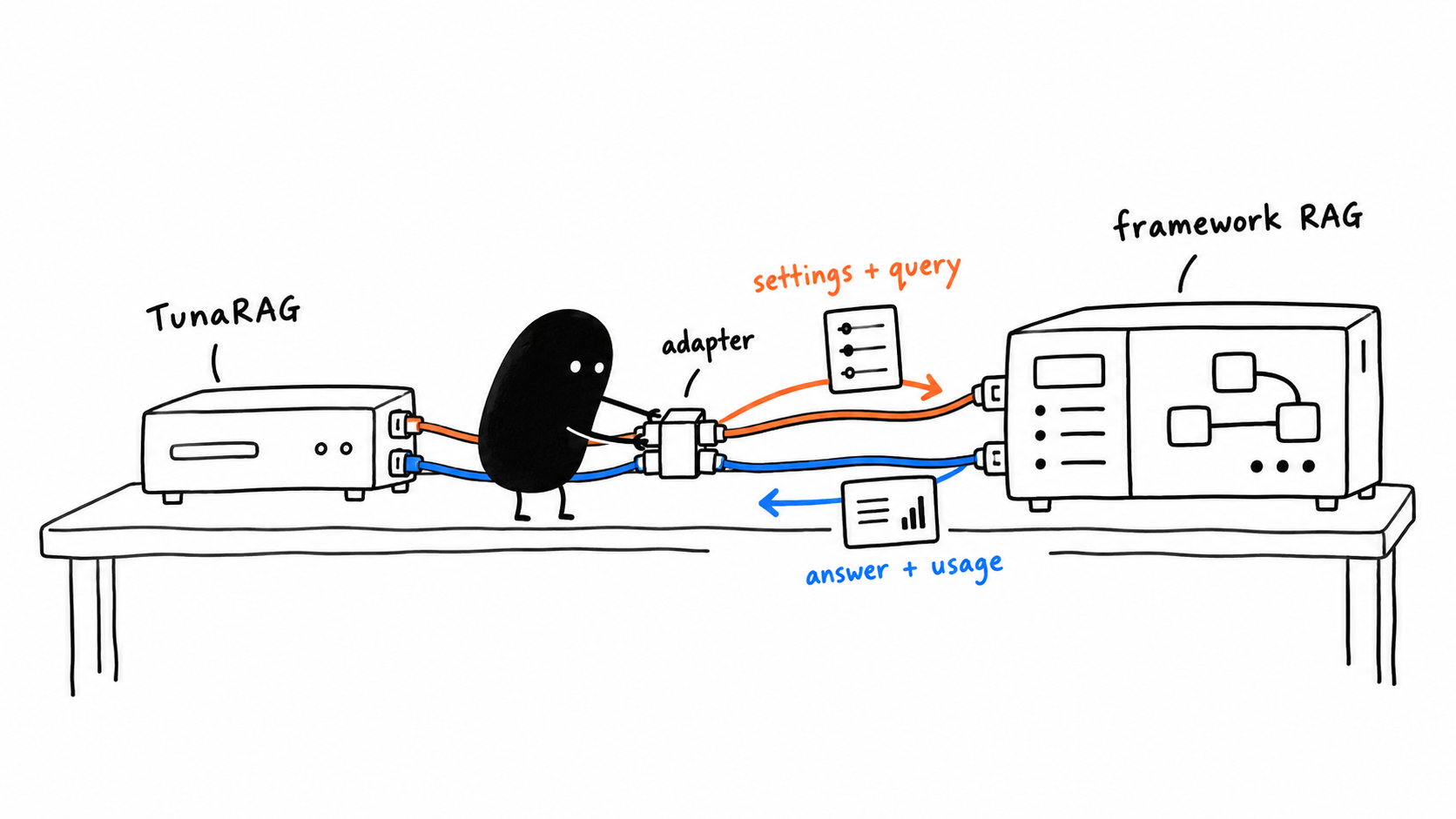
The adapter connects two responsibilities; it does not move your RAG into TunaRAG. Your framework must consume the candidate settings for tuning to change its behavior.
Candidate parameters go into framework configuration or initial ADK session state. A parameter only changes behavior if the framework consumes it. For model, prompt, retriever, or index choices that require rebuilding the pipeline, use a per-candidate framework factory. Mapping callbacks adapt framework inputs and outputs; they do not require implementing a RAG adapter.
from langchain_core.runnables import RunnableLambda
from tunarag import LangChainAdapter

adapter = LangChainAdapter(
    RunnableLambda(lambda inputs: {"answer": inputs["question"]}),
    identity={"index_revision": "docs-v1", "prompt_revision": "qa-v1"},
)
Include stable corpus, index, model, prompt, and mapper revisions in identity for cache and resume
compatibility. Never include credentials. Framework factories and mapping callbacks remain normal
Python configuration code; retrieval and generation execute through the framework.
LangChain integration
LangChainAdapter accepts a real LangChain Runnable with ainvoke(input, config=...).
from langchain_core.runnables import RunnableLambda
from tunarag import LangChainAdapter


async def answer(inputs, config):
    top_k = config["configurable"]["top_k"]
    return {"answer": f"Used top_k={top_k} for {inputs['question']}"}


chain = RunnableLambda(answer)
adapter = LangChainAdapter(
    chain,
    output_mapper=lambda output: output["answer"],
    identity={"chain": "support-rag", "version": 1},
)
For EvaluationExample, default input is {"question": example.query}. Candidate parameters are
placed in config["configurable"]. Other example types pass through unchanged.
Use a factory when candidates change construction-time components:
def build_chain(candidate):
    retriever = vector_store.as_retriever(search_kwargs={"k": candidate.parameters["top_k"]})
    return create_retrieval_chain(
        retriever,
        build_qa_chain(candidate.parameters["model"]),
    )


adapter = LangChainAdapter(
    factory=build_chain,
    input_key="input",
    output_mapper=lambda output: output["answer"],
    identity={"factory_schema": 1},
)
This factory fragment assumes vector_store and build_qa_chain(model) already exist. The
standard create_retrieval_chain requires the input key and comes from langchain-classic;
install that package and import it before using this fragment.
Customize all boundaries when required:
adapter = LangChainAdapter(
    chain,
    input_mapper=lambda example, candidate: {
        "input": example.query,
        "retrieval_limit": candidate.parameters["top_k"],
    },
    config_mapper=lambda candidate: {
        "configurable": {"model": candidate.parameters["model"]},
        "tags": ["tunarag-trial"],
    },
    output_mapper=lambda output: output["answer"],
    usage_mapper=lambda output: (
        UsageRecord(
            "langchain-provider",
            input_tokens=output["usage"]["input_tokens"],
            output_tokens=output["usage"]["output_tokens"],
        ),
    ),
)
The default usage mapper recursively discovers standard usage_metadata in mappings, sequences,
and message objects. The adapter always adds langchain.runnable latency. Set
capture_message_usage=False to disable automatic token extraction. A custom usage_mapper takes
precedence.
For a complete provider-backed pipeline—from documents and embeddings through optimization and
reports—run
examples/langchain_full_rag.py.
The example loads OPENROUTER_API_KEY from a repository-root .env file and uses OpenRouter for
both chat generation and embeddings; copy .env.example to .env to get started.
LangGraph integration
LangGraphAdapter has the same factory and mapping options.
from typing import TypedDict

from langgraph.graph import END, START, StateGraph
from tunarag import LangGraphAdapter


class State(TypedDict, total=False):
    question: str
    answer: str
    top_k: int


async def answer_node(state: State, config):
    top_k = state["top_k"] if "top_k" in state else config["configurable"]["top_k"]
    return {"answer": f"answer for {state['question']} with {top_k} documents"}


builder = StateGraph(State)
builder.add_node("answer", answer_node)
builder.add_edge(START, "answer")
builder.add_edge("answer", END)
graph = builder.compile()
adapter = LangGraphAdapter(
    graph,
    output_mapper=lambda state: state["answer"],
    identity={"graph": "qa", "revision": 1},
)
To place candidate values in graph state instead of runnable config:
adapter = LangGraphAdapter(
    graph,
    input_mapper=lambda example, candidate: {
        "question": example.query,
        "top_k": candidate.parameters["top_k"],
    },
    config_mapper=lambda candidate: None,
    output_mapper=lambda state: state["answer"],
)
The adapter always adds langgraph.runnable latency. Framework errors remain visible to the engine's
retry and failure handling.
Google ADK integration
Install tunarag-python[google-adk] on Python 3.10+. GoogleADKAdapter(runner) accepts a real ADK
2.x Runner or InMemoryRunner. Candidate parameters become initial session state. Each sample
and retry gets a fresh session, which is removed after success, failure, or cancellation. Providers,
agent tools, corpus retrieval, and runner ownership remain with the application.
Use factory=lambda candidate: build_runner(candidate) when tuning settings such as a model or
retrieval tool that require constructing an agent. state_mapper can map candidates to agent state;
output_mapper receives the final ADK event, allowing retrieval evidence to be exposed for RAGAS.
By default the output is {"answer": final_text}. Usage captures reported model token counts and
runner latency; dollar cost is unavailable unless your evaluator supplies a priced metric.
Missing final responses and ADK error events fail the trial rather than becoming empty answers.
See the executable ADK example and integration reference.
Evaluation datasets
Canonical model
from tunarag import DatasetSplit, EvaluationExample

example = EvaluationExample(
    id="billing-001",
    query="How can I update my billing address?",
    reference_answer="Open Settings, then Billing.",
    reference_contexts=("Billing addresses are under Settings > Billing.",),
    relevant_document_ids=("billing-guide",),
    tags=("billing", "how-to"),
    metadata={"tenant": "demo", "source": "support-review"},
    split=DatasetSplit.OPTIMIZE,
    synthetic=False,
)
Text is Unicode-normalized and line endings are canonicalized. IDs must be unique. Metadata must be finite JSON-compatible data. Duplicate tags and relevant document IDs are rejected.
Ingestion
from tunarag import DatasetFieldMap, EvaluationDataset

dataset = EvaluationDataset.from_records(
    [
        {
            "question_id": "q-1",
            "question": "What is TunaRAG?",
            "expected": "A RAG optimization library.",
            "contexts": ["TunaRAG optimizes existing RAG systems."],
            "metadata": {"tenant": "demo"},
        }
    ],
    field_map=DatasetFieldMap(
        id="question_id",
        query="question",
        reference_answer="expected",
        reference_contexts="contexts",
    ),
)
json_dataset = EvaluationDataset.from_json("evaluation.json")
jsonl_dataset = EvaluationDataset.from_jsonl("evaluation.jsonl")
csv_dataset = EvaluationDataset.from_csv("evaluation.csv")
JSON contains an array; JSONL contains one object per nonblank line. CSV collection and metadata
cells are JSON-encoded. Missing IDs are deterministically derived. Every EvaluationDataset has a
content-derived version used by caches and resume validation.
Deterministic splitting
from tunarag import DatasetSplit, SplitRatios

split_dataset = dataset.with_splits(
    seed=42,
    ratios=SplitRatios(optimize=0.7, validation=0.2, test=0.1),
    group_metadata_key="tenant",
)
optimization_data = split_dataset.select(DatasetSplit.OPTIMIZE)
Splits are hash-based and stable across input order. Group splitting keeps related examples
together. select() rejects an empty split.
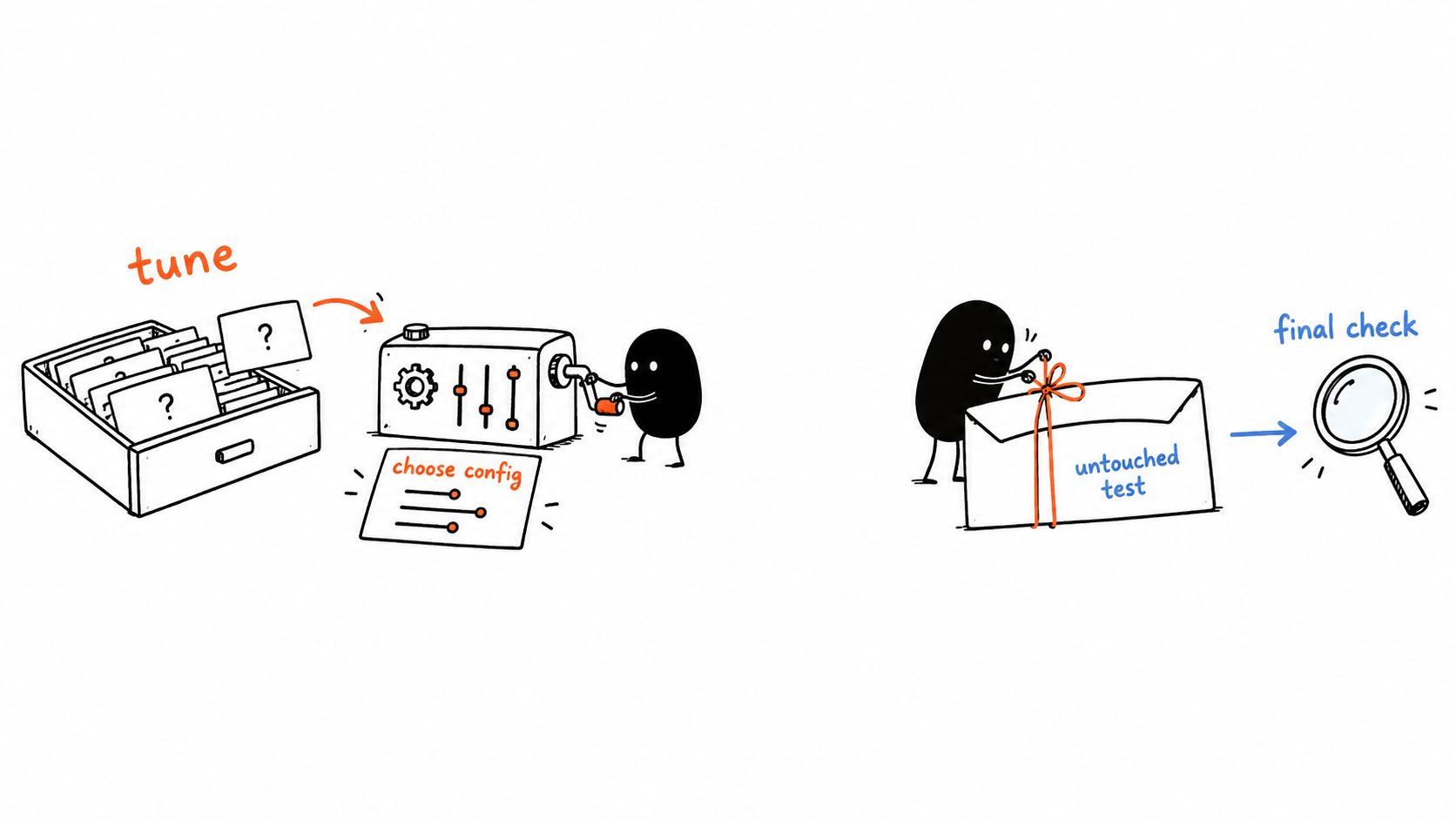
Pass only the selected optimization subset to the tuning study. Use validation data for
development decisions, and evaluate the frozen winner on the untouched test subset.
TunaRAG does not automatically enforce this separation or run the final held-out evaluation;
calling optimize() with the test set would use it for parameter selection and leak test data.
For custom examples, use a user-managed version:
from tunarag import InMemoryDataset

dataset = InMemoryDataset.from_iterable(
    [{"question": "Q1"}, {"question": "Q2"}],
    version="support-set-v4",
)
Change the version whenever custom example semantics change.
Synthetic QA generation
Generation is provider-neutral. A provider must return exactly the requested count.
from tunarag import (
    SourceDocument,
    SourceSpan,
    SyntheticDatasetBuilder,
    SyntheticGenerationResponse,
    SyntheticQA,
    UsageRecord,
)


class QAProvider:
    async def generate(self, request):
        text = request.document.text
        items = tuple(
            SyntheticQA(
                query=f"What does {request.document.id} explain?",
                answer=text,
                source_spans=(SourceSpan(0, len(text)),),
                confidence=0.9,
            )
            for _ in range(request.count)
        )
        return SyntheticGenerationResponse(
            items=items,
            usage=(UsageRecord("qa-generator", output_tokens=40),),
        )


builder = SyntheticDatasetBuilder(
    QAProvider(),
    samples_per_document=2,
    concurrency=4,
    seed=7,
    generator_version="qa-provider-v1",
)
generated = await builder.generate(
    [SourceDocument("guide", "TunaRAG optimizes existing RAG pipelines.")]
)
dataset = generated.dataset
generation_usage = generated.usage
SourceSpan is a zero-based half-open range. TunaRAG validates spans, confidence, cardinality,
source IDs, and usage. Generated examples carry provenance and synthetic=True. Review them before
using them as gold data. Generation usage is separate from optimization usage.
Search spaces and strategies
Typed space
from tunarag import Categorical, FloatRange, IntegerRange, SearchSpace

space = SearchSpace(
    {
        "top_k": IntegerRange(1, 10),  # inclusive
        "temperature": FloatRange(0.0, 0.8),
        "model": Categorical(("small", "large")),
        "prompt": Categorical(("concise", "grounded")),
    }
)
SearchSpace.validate() requires exactly the declared keys. Prefer JSON-like immutable categorical
values for portable persistence. Secrets should not be search parameters.
RandomSearch
Candidate order is reproducible for the same seed, space, and reservation history. Resume replays and verifies the random generator state.
LLMSearch
from tunarag import LLMSearch


class SuggestionProvider:
    def __init__(self, client):
        self.client = client

    async def suggest(self, request):
        return await self.client.generate_json(
            schema=request.search_space,
            context={
                "suggestion_number": request.suggestion_number,
                "attempt_number": request.attempt_number,
                "observations": [
                    {
                        "candidate": dict(item.candidate.parameters),
                        "metrics": [
                            {"name": metric.name, "value": metric.value} for metric in item.metrics
                        ],
                    }
                    for item in request.observations
                ],
            },
        )


strategy = LLMSearch(
    space,
    SuggestionProvider(llm_client),
    max_suggestion_attempts=3,
    fallback_seed=42,
    fallback=True,
)
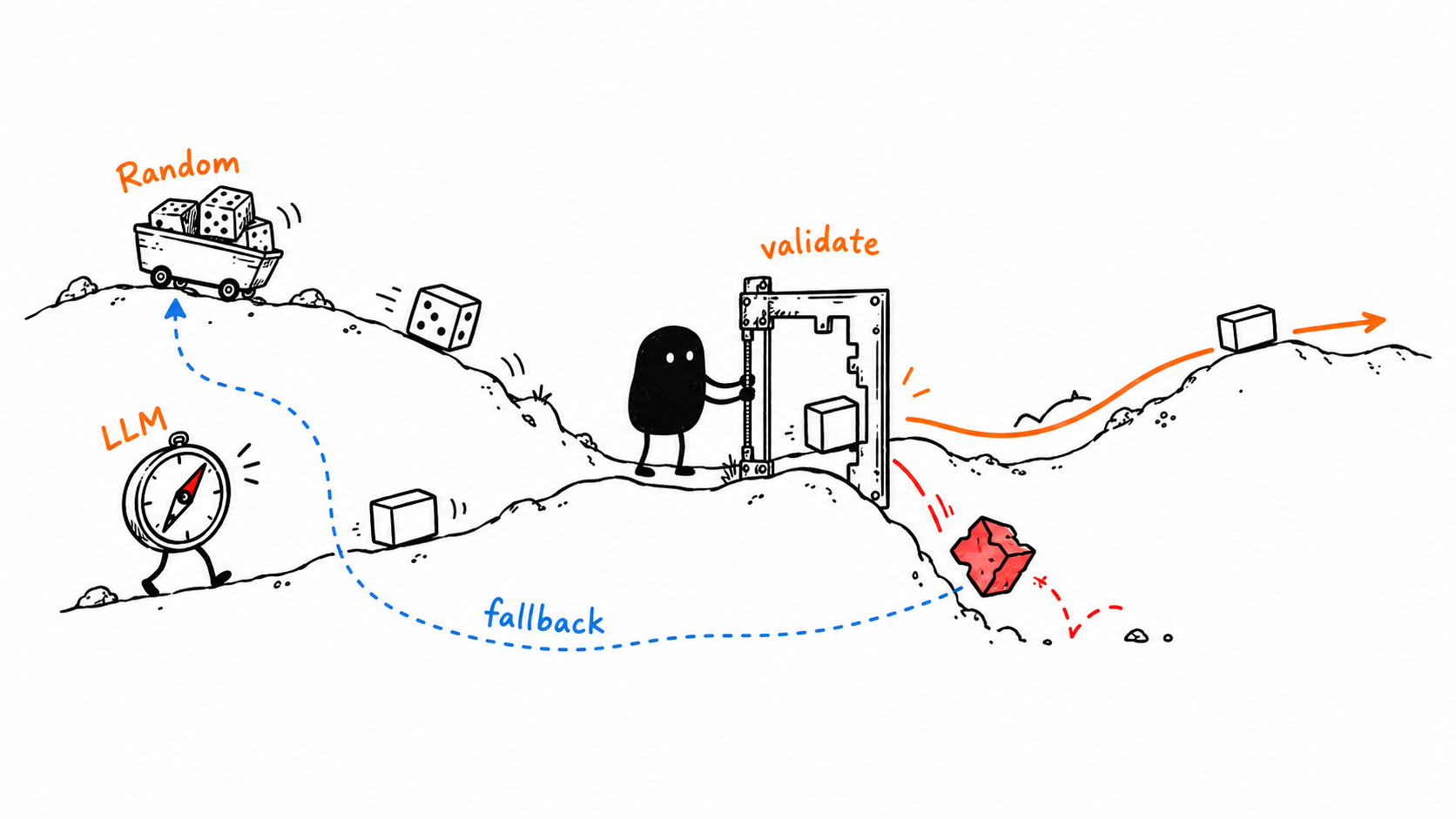
Proposals are strictly validated. Provider exceptions and invalid values consume a bounded attempt.
After exhaustion, deterministic random fallback runs when enabled; otherwise SearchSpaceError is
raised. Provider-facing observations are redacted.
Evaluators and RAGAS
Simple and custom evaluators
from tunarag import MetricEvaluator, MetricValue, ValueStatus


def exact_match(output, example):
    if example.reference_answer is None:
        return None
    return float(output["answer"].strip() == example.reference_answer.strip())


exact_match_evaluator = MetricEvaluator("exact_match", exact_match)


class RetrievalEvaluator:
    async def evaluate(self, output, example):
        retrieved = set(output["document_ids"])
        relevant = set(example.relevant_document_ids)
        recall = len(retrieved & relevant) / len(relevant) if relevant else None
        return (
            MetricValue(
                "retrieval_recall",
                recall,
                ValueStatus.EXACT,
                coverage=1.0 if relevant else 0.0,
            ),
            MetricValue("context_count", float(len(retrieved))),
        )

    def fingerprint(self):
        return {"evaluator": "retrieval", "version": 1}
MetricEvaluator accepts sync or async scorers. None, NaN, and infinity become unavailable;
nonnumeric values raise EvaluationError. Coverage must be [0, 1]. tunarag.objective is a
reserved metric name.
RAGAS
from ragas.metrics import AnswerRelevancy, Faithfulness
from tunarag import RagasEvaluator

ragas_evaluator = RagasEvaluator(
    metrics=(Faithfulness(), AnswerRelevancy()),
    sample_mapper=lambda output, example: {
        "user_input": example.query,
        "response": output["answer"],
        "retrieved_contexts": output["contexts"],
        "reference": example.reference_answer,
    },
    metric_prefix="ragas.",
    llm=evaluation_llm,
    embeddings=evaluation_embeddings,
    raise_exceptions=False,
)
TunaRAG constructs one RAGAS SingleTurnSample and calls the async evaluation API. Names receive
the configured prefix. Mapping and RAGAS failures become EvaluationError. Credentials and provider
configuration remain owned by your RAGAS components.
Objectives
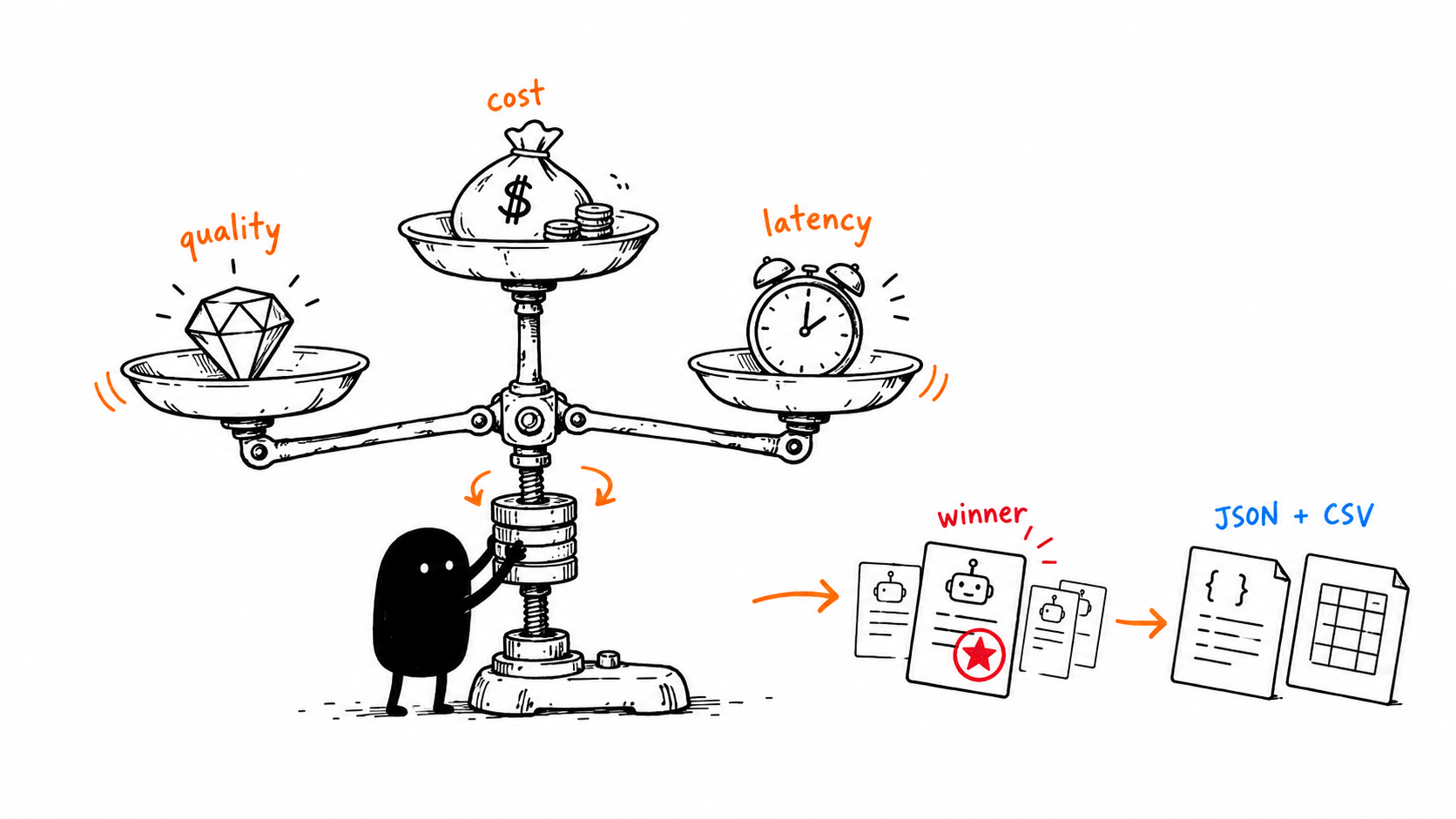
Your objective weights define the tradeoff; the winning configuration is best among the evaluated trials under that objective, not a guarantee of the globally best RAG.
from tunarag import Objective, ObjectiveDirection, ObjectiveTerm

objective = Objective(
    (
        ObjectiveTerm("answer_quality", weight=0.70, minimum=0.0, maximum=1.0),
        ObjectiveTerm(
            "cost_usd",
            weight=0.20,
            direction=ObjectiveDirection.MINIMIZE,
            minimum=0.0,
            maximum=0.05,
        ),
        ObjectiveTerm(
            "latency_seconds",
            weight=0.10,
            direction=ObjectiveDirection.MINIMIZE,
            minimum=0.0,
            maximum=5.0,
        ),
    )
)
Bounded metrics are normalized and clamped to [0, 1]; bounded minimize terms become
1 - normalized. Unbounded maximize terms use raw values and unbounded minimize terms use negative
values. Weights are contributions and are not automatically normalized. A missing or unavailable
required metric makes the objective unavailable.
Usage does not automatically become an objective metric. Emit cost_usd or latency_seconds from
an evaluator when you want those values in the objective.
Configuration
from tunarag import Settings

settings = Settings.resolve(
    config_path="tunarag.toml",
    overrides={"max_trials": 50, "concurrency": 4},
)
Precedence is defaults < TOML [tunarag] < environment < overrides. .env files are not loaded.
[tunarag]
home = ".tunarag"
db_path = ".tunarag/experiments.db"
cache_dir = ".tunarag/cache"
artifact_dir = ".tunarag/artifacts"
max_trials = 25
concurrency = 4
sample_concurrency = 8
seed = 0
max_retries = 2
sample_timeout_seconds = 60.0
trial_timeout_seconds = 300.0
cache_policy = "read_write"
| Environment variable | Default / meaning |
|---|---|
TUNARAG_HOME |
Platform application-data directory |
TUNARAG_DB_PATH |
<home>/experiments.db |
TUNARAG_CACHE_DIR |
<home>/cache |
TUNARAG_ARTIFACT_DIR |
<home>/artifacts |
TUNARAG_MAX_TRIALS |
25 |
TUNARAG_CONCURRENCY |
4 trials |
TUNARAG_SAMPLE_CONCURRENCY |
8 samples per trial |
TUNARAG_SEED |
0 |
TUNARAG_MAX_RETRIES |
2 |
TUNARAG_SAMPLE_TIMEOUT_SECONDS |
60.0 |
TUNARAG_TRIAL_TIMEOUT_SECONDS |
300.0 |
TUNARAG_CACHE_POLICY |
read_write |
Cache policies: off, read_only, write_only, read_write. Settings contain no provider keys.
Running optimization
Use async in async programs:
Use the sync wrapper only when no event loop is active:
Calling sync methods inside an event loop raises SyncInAsyncContextError.
Durable composition:
from pathlib import Path
from tunarag import (
    MaxFailures,
    MaxTrials,
    NoImprovement,
    Optimizer,
    RetryPolicy,
    SQLiteCache,
    SQLiteStore,
    Settings,
    TargetScore,
)

settings = Settings.resolve(
    overrides={
        "home": Path(".tunarag"),
        "db_path": Path(".tunarag/experiments.db"),
        "cache_dir": Path(".tunarag/cache"),
        "artifact_dir": Path(".tunarag/artifacts"),
        "concurrency": 2,
        "sample_concurrency": 8,
    },
    environ={},
)
settings.home.mkdir(parents=True, exist_ok=True)
settings.cache_dir.mkdir(parents=True, exist_ok=True)
store = SQLiteStore(settings.db_path)
cache = SQLiteCache(settings.cache_dir / "evaluations.db")
optimizer = Optimizer(
    adapter=adapter,
    strategy=strategy,
    evaluators=(quality_evaluator, retrieval_evaluator),
    objective=objective,
    store=store,
    cache=cache,
    settings=settings,
    stop_conditions=(
        MaxTrials(30),
        TargetScore(0.90),
        NoImprovement(patience=6, min_delta=0.01, warmup_trials=8),
        MaxFailures(5),
    ),
    retry_policy=RetryPolicy(
        max_retries=2,
        sample_timeout_seconds=45.0,
        trial_timeout_seconds=300.0,
        base_delay_seconds=0.5,
        max_delay_seconds=10.0,
    ),
)
try:
    result = await optimizer.aoptimize(dataset, study_name="support-rag-v4")
finally:
    cache.close()
    store.close()
When you pass a store, you own it. optimizer.close() closes only its internally created store.
Stopping, retries, and concurrency
Stop conditions are OR-composed:
| Condition | Stops when |
|---|---|
MaxTrials(limit) |
Completed trial count reaches the limit |
CostBudget(limit, count_estimated=True) |
Exact plus optional estimated cost reaches limit |
TimeBudget(seconds) |
Wall-clock duration reaches limit |
TargetScore(target) |
Any benefit-oriented objective reaches target |
MaxFailures(limit, consecutive=False) |
Total or trailing consecutive failures reach limit |
NoImprovement(patience, min_delta=0, warmup_trials=1) |
Best score stops improving |
Always include a hard bound. Conditions are checked between trial batches, so active trials can
finish after a cost, time, score, failure, or stagnation threshold is reached. Use concurrency=1
for strict between-trial stopping.
from tunarag import RetryPolicy

policy = RetryPolicy(
    max_retries=3,
    sample_timeout_seconds=30.0,
    trial_timeout_seconds=180.0,
    base_delay_seconds=0.25,
    max_delay_seconds=8.0,
)
Three retries means four total attempts. Timeouts and connection errors are retryable. A
TunaRAGError retries only when retryable=True; other exceptions fail that trial. Backoff is
deterministic and capped. Attempt usage is append-only, including failed attempts.
concurrency bounds simultaneous trials; sample_concurrency bounds samples inside each trial.
Their product approximates maximum concurrent adapter calls. Completion may be concurrent, but
results and strategy observations preserve trial-sequence order.
Caching
from pathlib import Path

from tunarag import CachePolicy, SQLiteCache, Settings

Path(".tunarag").mkdir(parents=True, exist_ok=True)
cache = SQLiteCache(".tunarag/evaluations.db")
settings = Settings.resolve(overrides={"cache_policy": CachePolicy.READ_WRITE}, environ={})
optimizer = Optimizer(
    adapter=adapter,
    strategy=strategy,
    evaluators=evaluators,
    objective=objective,
    cache=cache,
    settings=settings,
)
Identity includes dataset version, candidate, adapter, and evaluators. A hit skips adapter and evaluator execution but still calculates the objective and records the trial.
Direct API:
from tunarag import CacheKey, CachePrivacy, SQLiteCache

cache = SQLiteCache("cache.db")
key = CacheKey.from_parts("my-feature", {"query": "hello"}, format_version=1)
cache.put(key, b'{"answer":"world"}', privacy=CachePrivacy.SENSITIVE, ttl_seconds=3600)
lookup = cache.get(key)
if lookup.is_hit:
    payload = lookup.payload
cache.prune()
cache.close()
Statuses are hit, miss, expired, corrupt, and quarantined. Checksums detect corruption and
bad rows are quarantined. prune(include_quarantined=True) can remove quarantined rows. Privacy
labels are metadata, not encryption.
SQLite persistence and resume
from pathlib import Path

from tunarag import SQLiteStore

Path(".tunarag").mkdir(parents=True, exist_ok=True)
store = SQLiteStore(".tunarag/experiments.db")
optimizer = build_optimizer(store)
result = await optimizer.aoptimize(dataset, study_name="production-rag")

# Rebuild stateful components so replay begins from their initial state.
resumed_optimizer = build_optimizer(store)
resumed = await resumed_optimizer.aresume(dataset, study_id=result.study_id)
# Sync equivalent: resumed_optimizer.resume(dataset, study_id=result.study_id)
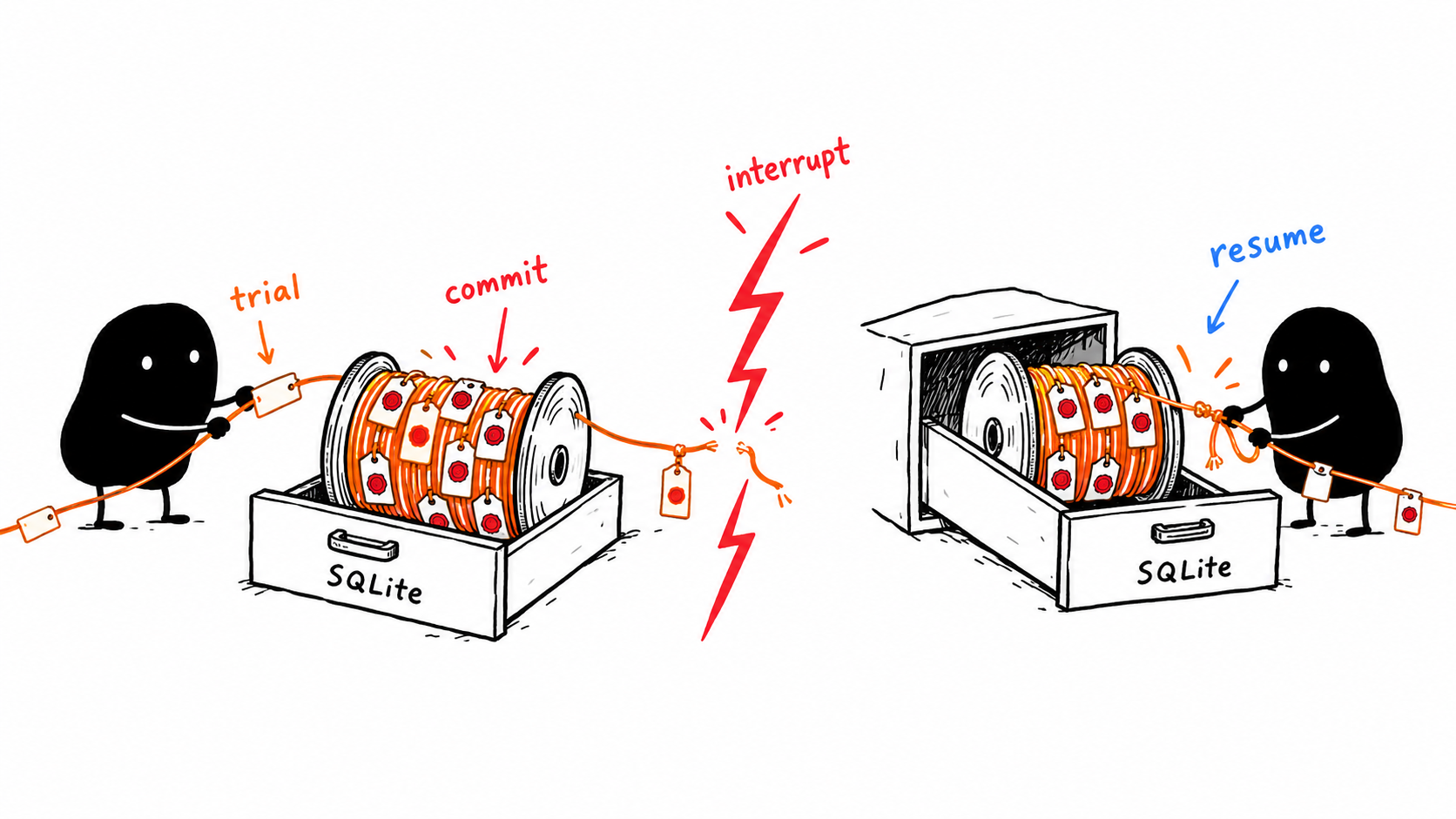
Resume validates semantic configuration and dataset identity, returns completed studies without
provider execution, abandons expired leases, replays committed strategy history, continues
unfinished work, and schedules new candidates. Unknown, failed, cancelled, or incompatible studies
raise ResumeError. An active lease produces a retryable error; retry later.
Read persisted state:
study = store.get_study(result.study_id)
trials = store.list_trials(result.study_id)
events = store.list_events(result.study_id, after_sequence=-1)
attempts = store.list_attempts(trials[0].id)
metrics = store.list_metrics(trials[0].id)
usage = store.list_usage(trials[0].id)
Normally let Optimizer own lifecycle mutations and use store read methods for inspection.
Callbacks and MLflow
Callbacks receive ordered durable events after commit:
class AuditCallback:
    async def on_event(self, event):
        print(event.sequence, event.type, event.study_id, dict(event.payload))


optimizer = Optimizer(
    adapter=adapter,
    strategy=strategy,
    evaluators=evaluators,
    objective=objective,
    callbacks=(AuditCallback(),),
)
Events cover study, trial, and attempt lifecycles plus callback failures. Handle unknown future event types defensively. Callback failures never roll back committed work; TunaRAG records them as durable events. Make callbacks idempotent.
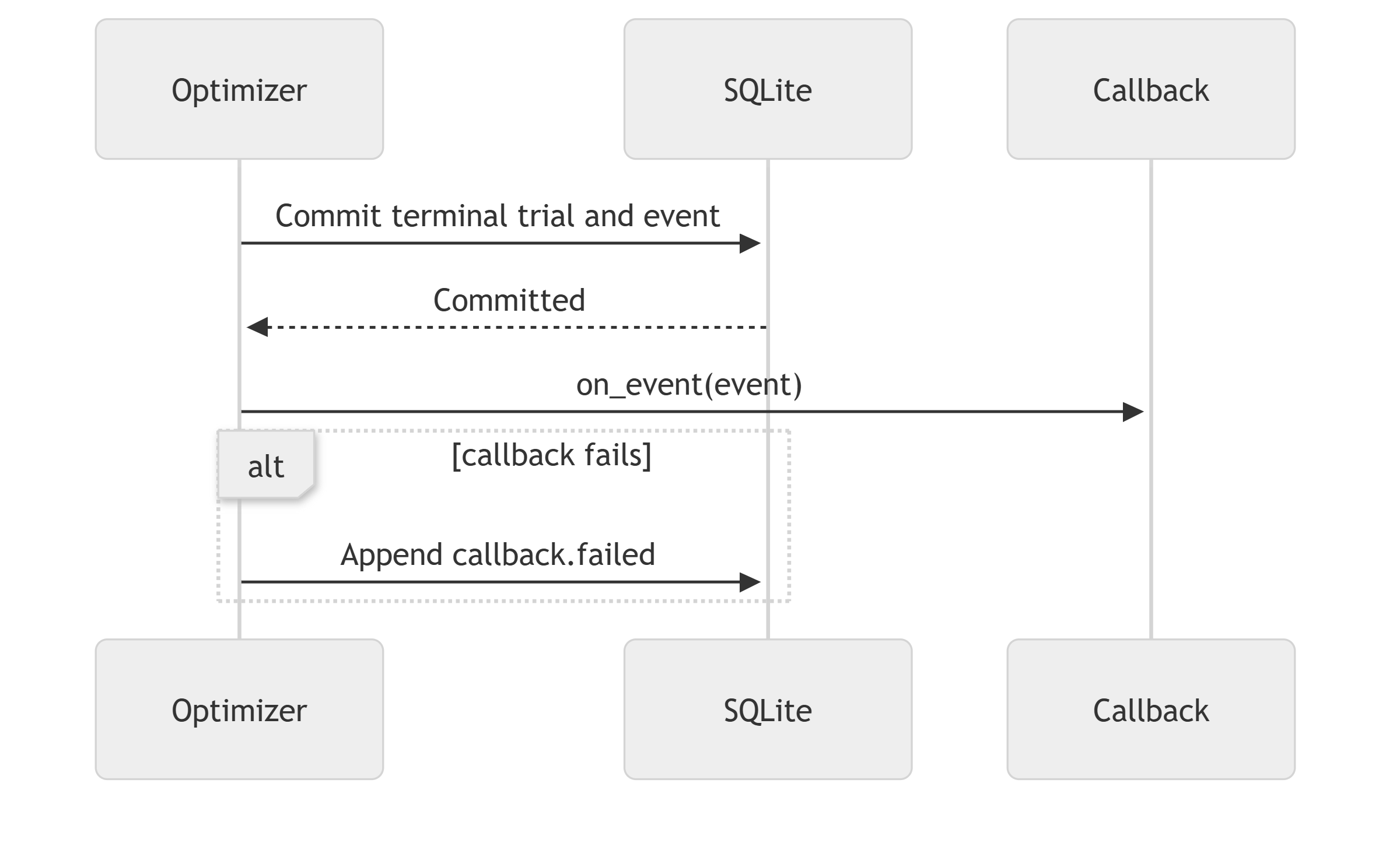
MLflow is an optional post-commit projection; SQLite remains authoritative:
from tunarag.integrations import MLflowCallback

callback = MLflowCallback(
    store,
    experiment_id="42",
    tracking_uri="https://mlflow.example.com",
    tags={"team": "search", "environment": "staging"},
)
optimizer = Optimizer(
    adapter=adapter,
    strategy=strategy,
    evaluators=evaluators,
    objective=objective,
    store=store,
    callbacks=(callback,),
)
One MLflow run is created per study. Candidate parameters, committed metrics, statuses, and event position are mirrored. An MLflow outage does not invalidate local results. Automatic external reconciliation is not included in V0.2.
Results and reports
OptimizationResult exposes:
result.study_id
result.study_status
result.stop_reason
result.trials
result.successful_trials
result.failed_trials
result.best_trial
result.best_candidate
result.ranked_trials
result.metric_names
result.usage
Rank by an individual metric:
from tunarag import ObjectiveDirection

quality_leaders = result.metric_leaders("answer_quality")
latency_leaders = result.metric_leaders("latency_seconds", direction=ObjectiveDirection.MINIMIZE)
Inspect and export:
from pathlib import Path

if result.ranked_trials:
    trial = result.ranked_trials[0]
    print(trial.candidate.parameters)
    print(trial.objective.score)
    print(trial.metric("answer_quality"))
    print(trial.attempts, trial.cached, trial.error)

print(result.to_json())
Path("artifacts").mkdir(parents=True, exist_ok=True)
result.write_json("artifacts/result.json")
result.write_csv("artifacts/trials.csv")
Reports are deterministic and redacted. Usage separates exact and estimated cost. A completed result may have no best candidate if every trial failed or every objective was unavailable.
Errors, privacy, and secrets
from tunarag import TunaRAGError

try:
    result = optimizer.optimize(dataset, study_name="example")
except TunaRAGError as error:
    diagnostic = error.as_dict()
    print(diagnostic["code"], diagnostic["stage"], diagnostic["retryable"])
Public subclasses include AdapterError, BudgetError, ConfigurationError, DatasetError,
EvaluationError, MissingOptionalDependencyError, ResumeError, SearchSpaceError, StoreError,
and SyncInAsyncContextError.
from tunarag import Secret

credential = Secret("do-not-log-this")
print(credential)  # ***redacted***
print(repr(credential))  # Secret(***redacted***)
TunaRAG redacts Secret and common sensitive keys from diagnostics, fingerprints, events, and
reports. This is defense in depth, not a secret manager. SQLite/cache files can contain prompts and
metadata; privacy labels do not encrypt. LLMSearch, synthetic generation, RAGAS, and callbacks may
send data to external providers. Apply filesystem permissions, encrypted storage, data minimization,
and provider-specific retention controls.
Extension contracts
Protocols are structural; inheritance is not required.
| Contract | Required behavior |
|---|---|
| Official framework adapters | LangChainAdapter, LangGraphAdapter, GoogleADKAdapter |
Dataset |
.version and async iteration |
Evaluator |
async evaluate(output, example) -> metrics |
SearchStrategy |
async suggest() and async observe(...) |
ReplayableSearchStrategy |
async replay(...) for resume |
Fingerprintable |
stable secret-safe fingerprint() |
EventCallback |
async on_event(event) |
Cache |
synchronous get() and put() |
Custom search-space parameters implement sample(generator), accepts(value), and describe():
class EvenInteger:
    def __init__(self, minimum, maximum):
        self.minimum = minimum
        self.maximum = maximum

    def sample(self, generator):
        values = tuple(range(self.minimum + self.minimum % 2, self.maximum + 1, 2))
        return generator.choice(values)

    def accepts(self, value):
        return (
            isinstance(value, int)
            and not isinstance(value, bool)
            and self.minimum <= value <= self.maximum
            and value % 2 == 0
        )

    def describe(self):
        return {
            "type": "integer",
            "minimum": self.minimum,
            "maximum": self.maximum,
            "multiple_of": 2,
        }
Provider descriptions and component fingerprints must not expose secrets.
Production checklist
- Use a file-backed
SQLiteStoreand back it up. - Keep a human-reviewed test split outside optimization.
- Supply framework pipeline revisions through adapter
identityand fingerprint custom evaluators. - Include a hard stopping bound and conservative concurrency.
- Track exact usage when available and label estimates.
- Configure sample and trial timeouts.
- Use deterministic seeds for reproducibility.
- Protect database and cache files; keep credentials outside TunaRAG objects.
- Make callbacks idempotent and monitor callback-failure events.
- Retain study IDs and exported reports with releases.
- Test resume behavior before expensive studies.
- Re-evaluate the winner on validation and test sets.
Limitations and glossary
V0.2 does not provide a hosted service/dashboard, automatic RAG construction, vector-database provisioning, distributed workers, Pareto optimization, Bayesian/evolutionary search, encrypted payloads, MLflow reconciliation, provider pricing management, or a TypeScript implementation. LangChain, LangGraph, and Google ADK 2.x are official integrations. Additional frameworks require a future first-party integration; custom RAG adapters are unsupported.
| Term | Meaning |
|---|---|
| Adapter | Runs the user-owned RAG for one candidate and example |
| Attempt | One trial execution, including retries |
| Candidate | Complete parameter mapping proposed by a strategy |
| Dataset version | Identity used for cache and resume compatibility |
| Evaluator | Converts one output/example pair into metrics |
| Fingerprint | Secret-safe semantic component identity |
| Objective | Converts trial metrics into one benefit score |
| Sample | One candidate evaluated against one example |
| Strategy | Proposes candidates and observes outcomes |
| Study | Durable optimization run containing trials |
| Trial | One candidate evaluated over the whole dataset |
| Usage | Tokens, cost, latency, confidence, and pricing provenance |
For deeper contracts and architecture, see the API specification, system architecture, and technical design.
License and responsibility
TunaRAG is distributed under the MIT License.
The full text and copyright notice are in the repository and distribution LICENSE file.
It permits use, modification,
and redistribution subject to retaining the copyright and permission notice. The software
is provided as is, without warranty, and the license includes a limitation of authors'
and copyright holders' liability. The complete license text, not this summary, governs.
You are responsible for testing fitness for your use case, validating generated answers, protecting data and credentials, setting provider-side spending limits, and monitoring costs. TunaRAG does not guarantee accuracy, security, optimization improvements, or provider bills. See the Security Policy for boundaries and known responsibilities.
No license can guarantee protection from every claim or override applicable mandatory law. Seek qualified legal advice for liability-sensitive use or distribution.